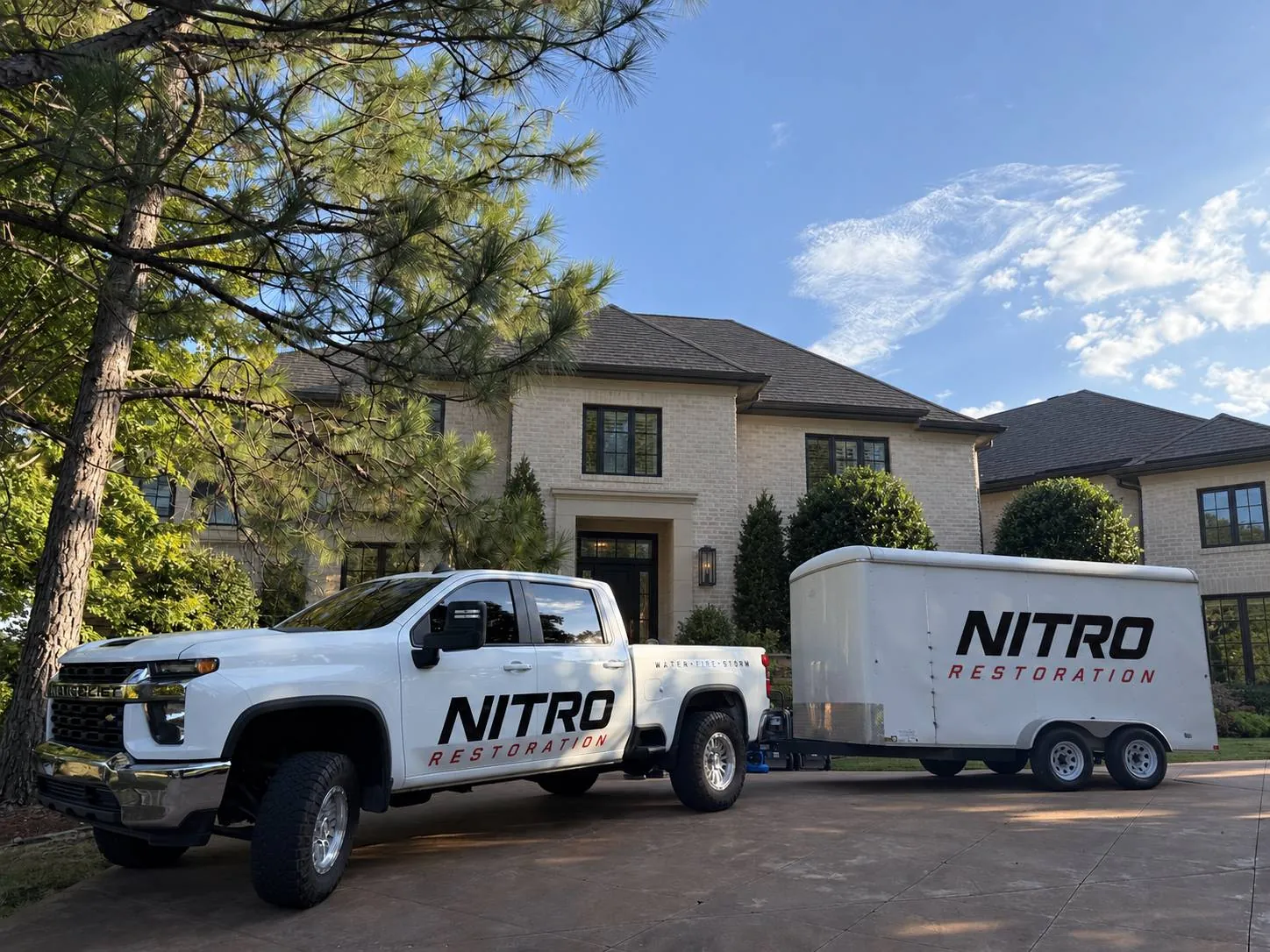
Water damage restoration in Tulsa: free on-site assessment, moisture readings and drying from a local Tulsa-area crew. Call or text (918) 550-2555, phones answered 24/7.
Nitro Restoration is a mobile water damage restoration crew serving Tulsa homes and businesses. Free assessment with thermal imaging and moisture readings, and an honest answer about whether you need us.
Tulsa's flood history reaches well beyond the Arkansas River. The National Weather Service account of May 26-27, 1984 identifies Mingo Creek and its tributaries as the center of concentrated damage. The entire Mingo Creek basin received at least nine inches of rain during that event. That is historical context, not a prediction for your address. It is a reason to ask how water entered before deciding what cleanup involves.
Tell us whether water rose from outside, arrived through a ceiling or escaped from an indoor line. Those are different starting points for an assessment. We map the affected materials and explain what the readings show. A room that looks untouched may still share wet materials with the room beside it. Learn more about water damage restoration.
The NWS survey of the August 6, 2017 Tulsa tornado describes businesses losing roofs and exterior walls near East 41st Street between Yale and Sheridan. Other buildings farther east had roof, wall and window damage. Tulsa storm damage is not limited to spring, and the opening visible outside is only part of the problem after rain enters.
Once the building is safe to enter, point out damaged ceilings, window surrounds and any rooms below an opening. Photographs taken from a safe location can help preserve what you first noticed. Our moisture assessment follows the water into accessible building materials. We separate the drying question from repairs to the exterior, so you understand which wet areas need attention rather than assuming every room needs the same work. Learn more about storm damage.
The Mingo Creek flood record is a reminder that outside water can wet more than the visible floor. After any Tulsa water loss, mold is a risk where materials remain damp; a creek name or neighborhood alone does not prove a mold problem. EPA water-damage guidance specifically calls for checking underflooring and addressing wet wall cavities, not just wiping the exposed surface.
We test moisture levels and assess the affected area before recommending anything. Tell us when the water arrived, when it stopped and whether the room has stayed closed or musty. That history helps direct the inspection without treating an odor as a diagnosis. The aim is a clear distinction between materials that need drying and conditions that may require a separate mold-remediation scope. Learn more about mold remediation.
Tulsa's Fire Prevention Division combines investigations, code enforcement, public education and community risk reduction. Its work is a reminder that a fire scene involves safety and cause questions before cleanup begins. Follow the responding department's instructions and do not re-enter until officials say it is safe.
Afterward, the water used to put out a fire needs drying too. A recovery assessment should distinguish heat and smoke effects from wet ceilings, wall cavities and contents. Record which rooms were affected without disturbing potential evidence. Ask what can be assessed now, what needs specialist evaluation and which work must wait for clearance. Read about fire and smoke damage.
Yes, partial scope is fine; the assessment helps define the affected area.

A Tulsa water problem usually involves up to three parties, and calling the wrong one first costs time. Here's the split.
Kitchen leak? Tulsa kitchen leak water damage: what we found in two real kitchens →
After a plumber stops a leak, the next question is what stayed wet. Moisture can remain trapped where you can't see it: under wood floors, behind baseboards, inside the wall. Left there, it may damage materials or support mold growth. The free assessment tells you honestly whether that's happening.
Our free assessment uses a thermal camera and moisture meters to map what's actually wet. If it's minor, we'll tell you. If it needs drying, a typical dry-out averages 4 to 7 days with daily monitoring. You can hire us for part of the job; partial scope is fine.
Water that came in from outside during a storm is often handled differently by insurance than a burst pipe. Before you assume coverage either way, read how insurance works on a covered loss. The City of Tulsa also publishes a floodplain map viewer, linked from its Water & Sewer page.
For roof, siding and wind-driven water, see storm damage.
For covered losses we bill your insurance directly, with the readings, photos and scope carriers ask for. There's no down payment for an emergency dry-out on an insurance claim. We work for you, not the insurance company; your adjuster and your policy decide what's covered.
If water is coming from a public main, a street break or a sewer overflow, report it to the City of Tulsa using the numbers on its Water & Sewer page. If water is inside your home or business, call us at (918) 550-2555 for a free assessment of what got wet.
No. The assessment is free, no strings attached and no obligation.
Phones are answered 24/7. Arrival depends on where you are and what's already on the schedule, and we'll give you an honest arrival time when you call.
Yes. We work on residential and commercial properties.
Tulsa Water Dispatch, (918) 596-9488. Sewer overflows go to (918) 586-6999.
Yes. Two Tulsa kitchens in October and November 2026, both written up with dates and moisture readings on our completed jobs page.
Midtown neighborhoods like Maple Ridge, Brookside and Florence Park are full of older homes on pier-and-beam foundations, where water drops into the crawlspace and stays out of sight. South Tulsa and the newer east-side subdivisions sit on slabs, where water wicks into drywall and under flooring instead. We assess both the same way: readings first, then a plan that fits the house in front of us.
Tulsa's raw water comes from Spavinaw and Eucha lakes and Lake Oologah, and it's treated at the Mohawk and A.B. Jewell plants, per the city's Water and Sewer department. That system ends at your meter. Everything past it, including the supply lines, the water heater and the dishwasher hose, is on the homeowner.
If water is coming up out of the yard or the street, call Tulsa Water Dispatch at (918) 596-9488. For a sewer overflow, call (918) 586-6999. If it's inside the house, shut off the main, get the leak fixed, then call us. Our most recent Tulsa jobs were both kitchens, and we wrote up what we found in them on our Tulsa kitchen leak page.
Every job story shows what we found, the readings and how the drying went. Tulsa homeowners can see exactly how we work.
Each city page covers a different water-damage question. Phones are answered 24/7 for all of them, and the assessment is free at any distance. Not listed? We cover roughly a 75-mile radius around Tulsa; see the full service area.
Tell us how to reach you and we'll call you back to talk through what happened, and whether you actually need restoration.
Water actively coming in? Don't wait on a form. Call now, phones are answered 24/7.
(918) 550-2555